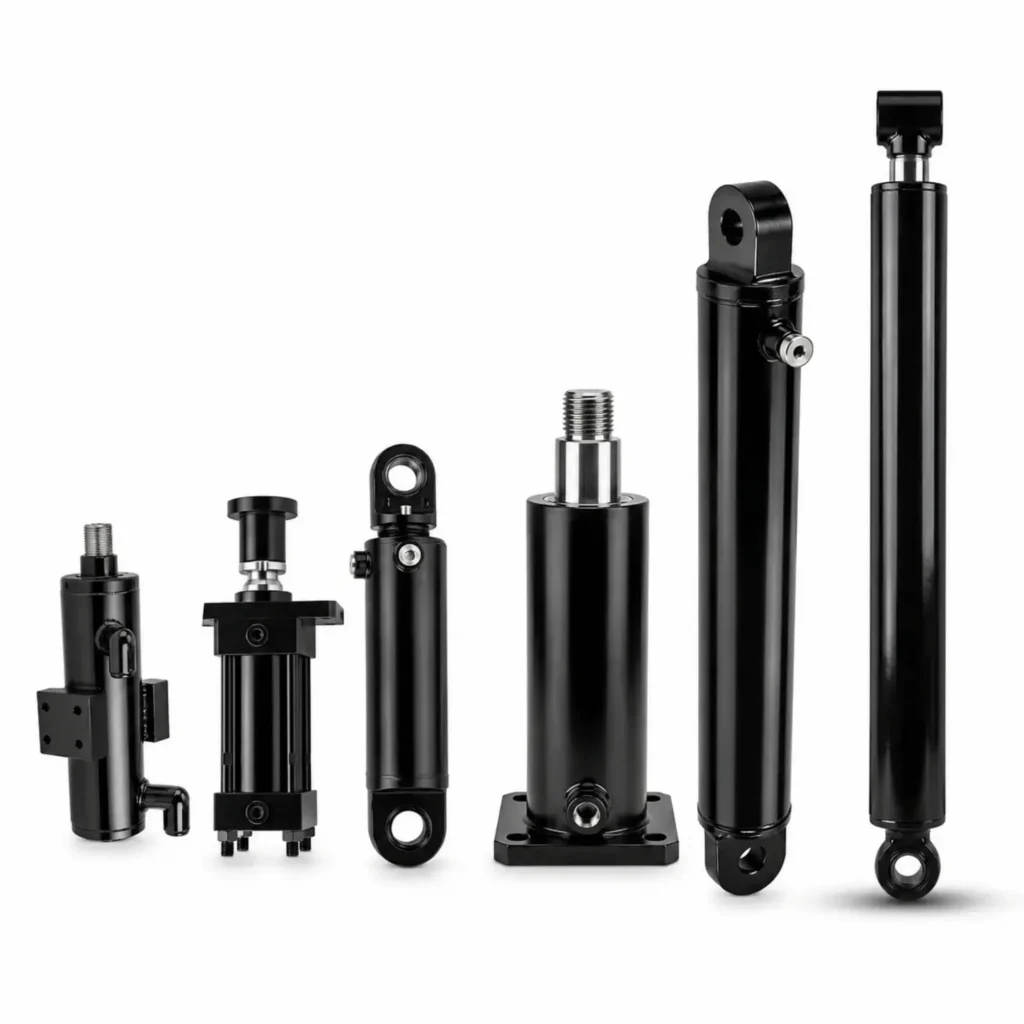
A tie rod hydraulic cylinder holds its head and cap against the barrel with four high-tensile steel tie rods, torqued to a set preload. Nothing is welded. That single design choice is why it is the standard cylinder on factory floors: it comes apart on a bench, gets resealed, and goes back into the machine the same shift.
Built to ISO 6020/2 or DIN 24554 dimensions, a tie rod cylinder is also interchangeable — the mounting pattern, port positions and rod threads match the standard, so it drops into an existing machine without re-engineering anything. For a plant replacing an imported cylinder, that matters more than any spec on the datasheet.
Fiable Hydraulics manufactures tie rod cylinders to order at our ISO 9001:2015 certified plant in Chakan, Pune. Bore, stroke, mounting style, port position, cushioning and seal package are built to your drawing or to the standard your machine already uses. Every cylinder is pressure, function and leak tested before dispatch. Fifteen years supplying OEMs, machine builders and exporters across India and 20+ countries.
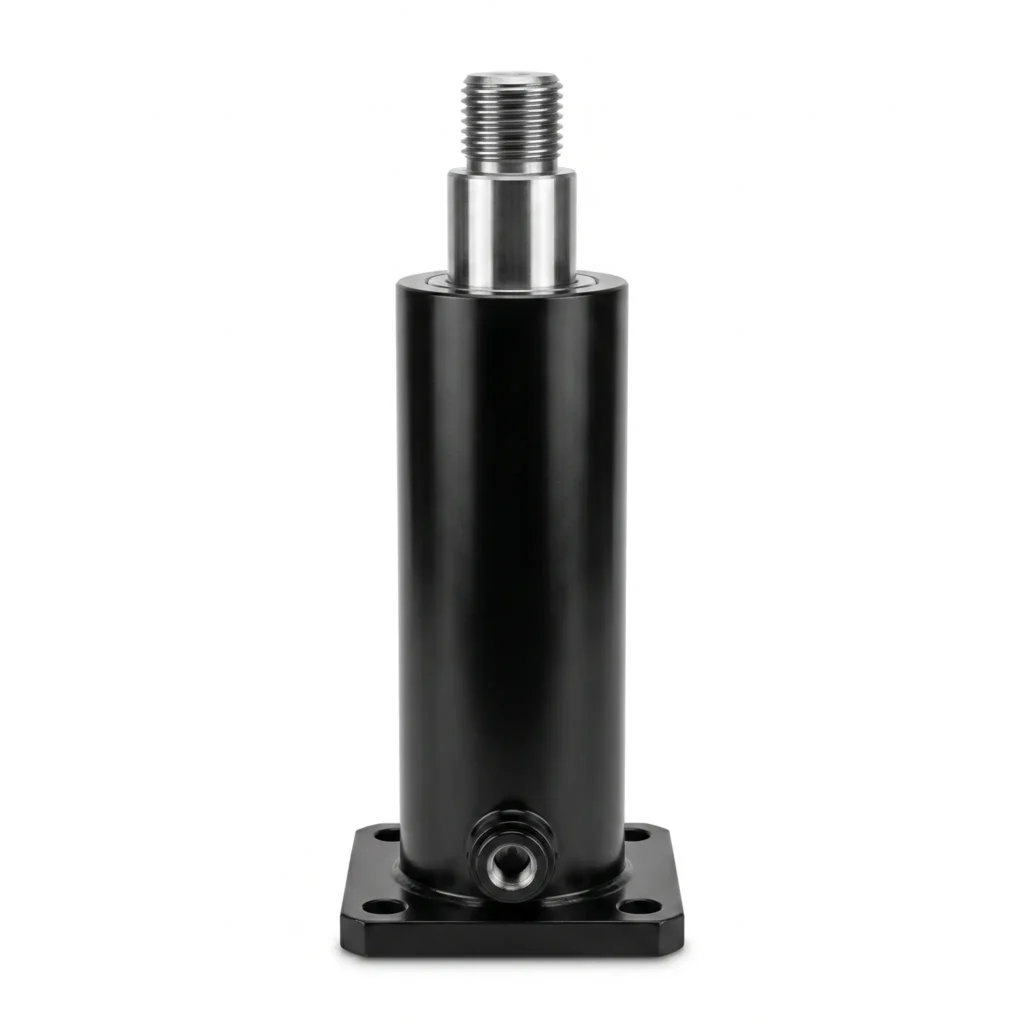
Click and drag to interact in 360° and explore structural dimensions.
Parameter |
Range |
|---|---|
Standard
|
ISO 6020/2 · DIN 24554 · ISO 6022 (confirm which you build)
|
Bore size
|
(confirm — mm)
|
Rod diameter
|
(confirm — mm)
|
Stroke
| |
Nominal working pressure
|
160 bar (ISO 6020/2 — confirm your rating)
|
Test pressure
|
(confirm — bar)
|
Action
|
Double acting standard; single acting on request
|
Mounting
|
Flange, foot, clevis, eye, trunnion — per standard or to drawing
|
Component |
Material |
Tolerance |
|---|---|---|
Honed tube
|
ST 52.3
|
H8 / H9
|
Piston rod
|
EN 8 / EN 9 / EN 19 / EN 31, hard chrome plated
|
f7
|
Piston & gland
|
EN 8
|
—
|
Seals
|
Parker, Hallite, Royal
|
—
|
Theoretical force at 450 bar. Push uses the full bore area; pull uses the annular area. Actual output is slightly lower after seal friction.
Bore (mm) |
Rod (mm) |
Push (kN) |
Push (t) |
Pull (kN) |
Pull (t) |
Push : Pull |
|---|---|---|---|---|---|---|
40
|
25
|
57
|
5.8
|
34
|
3.5
|
1.64
|
63
|
36
|
140
|
14.3
|
94
|
9.6
|
1.48
|
80
|
45
|
226
|
23.1
|
155
|
15.8
|
1.46
|
100
|
56
|
353
|
36.0
|
243
|
24.7
|
1.46
|
125
|
70
|
552
|
56.3
|
379
|
38.7
|
1.45
|
160
|
90
|
905
|
92.3
|
619
|
63.1
|
1.46
|
200
|
110
|
1,414
|
144.2
|
986
|
100.5
|
1.43
|
250
|
140
|
2,209
|
225.2
|
1516
|
154.6
|
1.46
|
At a standard rod-to-bore ratio of around 0.55, pull force runs roughly 30–35% below push force. If your return stroke has to work against a real load, tell us —a larger rod raises pull force and buckling resistance, at the cost of more oil to extend.
Feature |
Tie Rod |
Welded |
|---|---|---|
Construction
|
Bolted, four tie rods under preload
|
Head and cap welded to barrel
|
Rebuildable in the field
|
Yes — unbolt, reseal, reassemble
|
Limited; often returned or replaced
|
Envelope
|
Larger — tie rods sit outside the barrel
|
Compact, no external hardware
|
Typical pressure
|
Moderate — ISO 6020/2 is a 160 bar standard
|
Higher, up to 450 bar on our welded range
|
Less tolerant — preload can relax under heavy shock
|
More tolerant
| |
Dirt and impact exposure
|
Tie rods and threads exposed
|
Smooth body, nothing to catch
|
Interchangeability
|
High — ISO/DIN dimensions are standard
|
Built to the individual machine
|
Best for
|
Presses, machine tools, automation, factory equipment
|
Mobile equipment, earthmoving, mill duty, heavy shock
|
Choose tie rod for indoor industrial duty where rebuildability and standard interchangeability are worth more than compactness — presses, machine tools, plastics, packaging, automation.
Choose welded for mobile equipment, dirty or high-shock environments, higher working pressures, or where the envelope is tight.
Not sure? Tell us the machine, the pressure and the environment and we will tell you which construction to use. 👉 Heavy Duty Welded Hydraulic Cylinders · Mill Duty Hydraulic Cylinders
The reason a tie rod cylinder is specified by standard rather than by brand:
ISO 6020/2 — the international metric standard for medium-pressure tie rod cylinders, nominal 160 bar. Defines mounting dimensions, bore and rod combinations, port positions and rod threads.
DIN 24554 — dimensionally aligned with ISO 6020/2, and what most European-built machines in Indian plants were originally fitted with.
ISO 6022 — the heavy-duty metric series for higher pressures.
NFPA — the North American inch-based standard. Not interchangeable with ISO metric cylinders, even where bore sizes look similar. If your machine is American-built, check which one you actually have before ordering.
What this means when you are replacing a cylinder: a cylinder built to ISO 6020/2 will bolt into a mounting designed for ISO 6020/2 regardless of who made the original. You are not locked into the OEM’s supplier or their lead time.
Send us the make and model of the cylinder you are replacing, or the mounting dimensions off the machine, and we will confirm which standard it is and cross-reference it.
The standards define the mounting patterns, which is what makes a drop-in replacement possible. Common styles:
Rigid mounts (flange, foot) for loads that travel in a straight line. Pivot mounts (clevis, eye, trunnion) where the cylinder has to swing as the load moves. Getting this wrong puts side load on the rod and the gland, and that is the most common reason a cylinder fails early.
Our tie rod hydraulic cylinders are used on factory machines, presses and automation lines where a cylinder must be easy to service and interchangeable with standard mountings.
Every cylinder starts as ST 52.3 tube and EN-series bar stock. CNC machining brings tube, rod, piston and gland to tolerance, the tube is honed, and the cylinder is assembled with seals chosen for the fluid, pressure and temperature it will run in.
Before anything leaves our 50,000+ sq. ft. Chakan facility it goes through pressure testing, function testing and leak testing through the full stroke — extending and retracting — so both directions are proven, not just the push.
Got questions about ordering, delivery, or custom designs? Find your answers below.
A tie rod cylinder holds its head and cap against the barrel with four high-tensile steel tie rods, torqued to a set preload. Nothing is welded, so it can be stripped, resealed and refitted quickly. When built to ISO 6020/2 or DIN 24554 dimensions, its mountings are interchangeable with other cylinders built to the same standard.
On the retract stroke, oil acts on the annular area — the bore area minus the rod area — because the rod occupies part of that face. At a typical rod-to-bore ratio, pull force runs about 30–35% below push force at the same pressure. A larger rod raises pull force.
Push = (π ÷ 4) × bore² × pressure. Pull = (π ÷ 4) × (bore² − rod²) × pressure. A 100 mm bore with a 56 mm rod at 450 bar gives about 353 kN pushing and 243 kN pulling — roughly 36 and 25 tonnes. Allow a margin for seal friction.
Yes. Bore, rod, stroke, mounting, port position, cushioning and seal package are all built to your drawing or application data. You get a general-arrangement drawing to approve before machining starts.
Cushioning is available fixed or adjustable, at either end or both. We recommend it on high-speed and high-cycle circuits — it is the cheapest way to protect the seals and end caps from end-of-stroke shock.
Bore 40 mm to 250 mm, rod 16 mm to 200 mm, stroke up to 6000 mm, working pressures up to 450 bar. Outside that range, send the requirement and we will confirm feasibility.
Use double acting when the rod must be powered both ways, when the cylinder is mounted horizontally, or when you need to hold position mid-stroke. Use single acting when the load or a spring can reliably bring the rod back. Send us the application and we will tell you which one — including when the cheaper option is the right one.
Yes. We supply to more than 20 countries from our Chakan, Pune facility and handle export documentation and packing.
Fiable Hydraulics Pvt. Ltd. is an ISO 9001:2015 certified manufacturer of hydraulic cylinders, power packs and complete hydraulic systems — designed, machined and pressure-tested at our facility in MIDC Chakan, Pune.
© 2026 Fiable Hydraulics Pvt. Ltd. All Rights Reserved. |Privacy Policy|Terms & Conditions
ISO 9001:2015 Certified · Manufactured in Pune, India
WhatsApp us
Share your requirement — our team replies within 24 hours.